Effect of Epidemiological Factors on Anthracnose Disease Development in Green Gram incited by Colletotrichum truncatum in Arid Ecosystem of India
Authors: Kailash Patel, A. L. Yadav, Ashok Kumar, Rahul Jakhar, Sunita Dhaka, Chetan Chopra, A. Ratan Kumar Singh, S. K. Maheshwari
Journal: Legume Research-An International Journal
Volume: 6.0 Issue: Year: 2026
Phenotypic validation and SSR marker Associations in Sesame Germplasm Contrasting for Dry Root Rot (Macrophominaphaseolina) Tolerance
Authors: Saba Khan, Ritu Tiwari, Jameel Akhtar, Arjun Lal Yaddav, Kartar Singh, Senthilraja Govindasamy, Mahalingam Angamuthu, Pankaj Sharma, Kailash Narayan Gupta, rashmi Yadav, Parimalan Rangan
Journal: Journal of Phytopathology
Volume: 7.1 &1.1 Issue: Year: 2026
Sustainable management of Alternaria leaf Blight in isabgol(Plantago ovata) using chitosan, multi walled carbon nanotubes and salicylic acid.
Authors: Frontiers in sustainable food systems
Journal: Frontiers in sustainable food systems
Volume: 9.10 & 3.1 Issue: Year: 2026
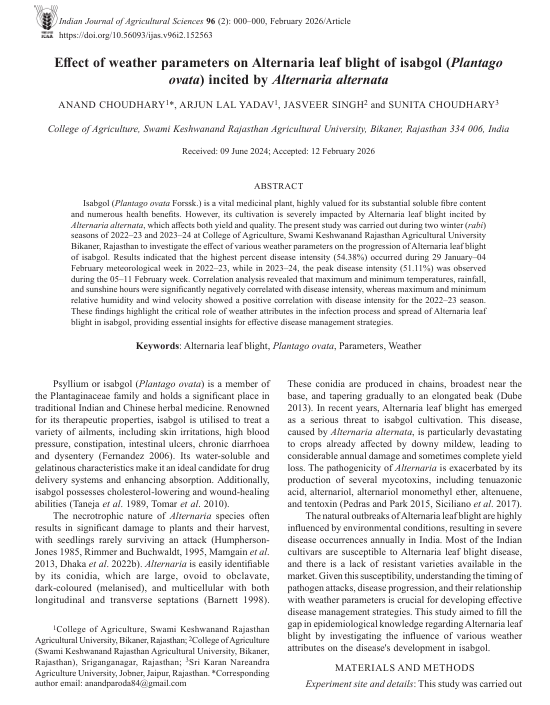
Effect of weather parameters on Alternaria leaf blight of isabgol(Plantago ovata) incited by Alternaria alternata
Authors: Anand Choudhary, Arjun Lal Yadav,Jasveer Singh, Sunita Choudhary
Journal: Indian Journal of Agricultural Sciences
Volume: 6.0 Issue: Year: 2026
Isabgol (Plantago ovata Forssk.) is a vital medicinal plant, highly valued for its substantial soluble fibre content and numerous health benefits. However, its cultivation is severely impacted by Alternaria leaf blight incited by Alternaria alternata, which affects both yield and quality. The present study was carried out during two winter (rabi) seasons of 2022–23 and 2023–24 at College of Agriculture, Swami Keshwanand Rajasthan Agricultural University Bikaner, Rajasthan to investigate the effect of various weather parameters on the progression of Alternaria leaf blight of isabgol. Results indicated that the highest percent disease intensity (54.38%) occurred during 29 January–04 February meteorological week in 2022–23, while in 2023–24, the peak disease intensity (51.11%) was observed during the 05–11 February week. Correlation analysis revealed that maximum and minimum temperatures, rainfall, and sunshine hours were significantly negatively correlated with disease intensity, whereas maximum and minimum relative humidity and wind velocity showed a positive correlation with disease intensity for the 2022–23 season. These findings highlight the critical role of weather attributes in the infection process and spread of Alternaria leaf blight in isabgol, providing essential insights for effective disease management strategies.
Anthracnose of Soyabean: Occurrence , Epidemiology and management Apporaches
Authors: Manoj Kumar Yadav, Chandrakant Singh, Dasari Sreekanth, Aditya Kumar, Sujit Kumar, Sanjeev Kumar, P Duraimurugan, Archana Anokhe, Arjun Lal Yadav
Journal: Journal of Oilseed Research
Volume: 4.78 Issue: Year: 2025
Prevalence and Severity of Anthracnose disease of Green gram[Vigna radiate (L)] caused by Colletotricumtruncatum (Schw.)in Arid Ecosystem of India
Authors: Kailash Patel, A. L. Yadav, Ashok Kumar,Pranabdutta, a Ratankumar Singh, SushantiThokchom, Rahul Jakhar, Jasveer singh
Journal: Plant Science Today
Volume: 6.0 Issue: Year: 2025
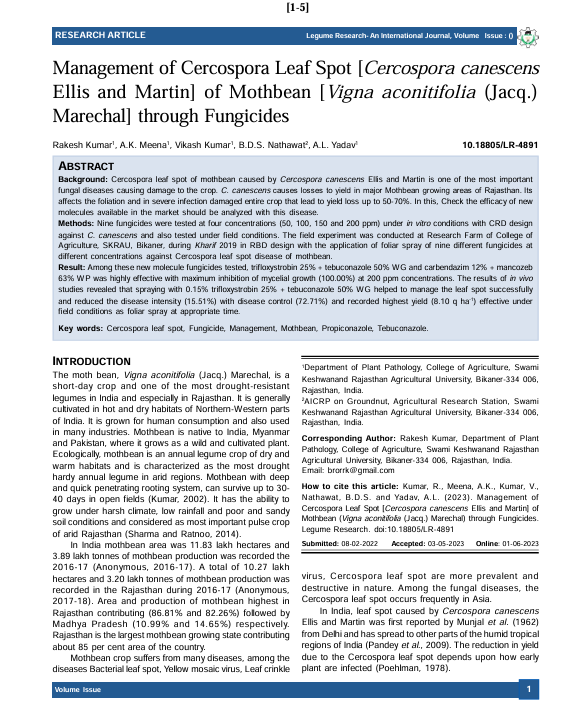
Management of Cercospora leaf Spot (Cercosporacanescens Ellis and Martin) of Mothbean through Fungicides
Authors: Rakesh Kumar, A.K. Meena, Vikash Kumar, B. D. S. Nathawat and A. L. Yadav
Journal: Legume Research-An International Journal
Volume: 6.0 Issue: Year: 2024
Background: Cercospora leaf spot of mothbean caused by Cercospora canescens Ellis and Martin is one of the most important fungal diseases causing damage to the crop. C. canescens causes losses to yield in major Mothbean growing areas of Rajasthan. Its affects the foliation and in severe infection damaged entire crop that lead to yield loss up to 50-70%. In this, Check the efficacy of new molecules available in the market should be analyzed with this disease.
Methods: Nine fungicides were tested at four concentrations (50, 100, 150 and 200 ppm) under in vitro conditions with CRD design against C. canescens and also tested under field conditions. The field experiment was conducted at Research Farm of College of Agriculture, SKRAU, Bikaner, during Kharif 2019 in RBD design with the application of foliar spray of nine different fungicides at different concentrations against Cercospora leaf spot disease of mothbean.
Result: Among these new molecule fungicides tested, trifloxystrobin 25% + tebuconazole 50% WG and carbendazim 12% + mancozeb 63% WP was highly effective with maximum inhibition of mycelial growth (100.00%) at 200 ppm concentrations. The results of in vivo studies revealed that spraying with 0.15% trifloxystrobin 25% + tebuconazole 50% WG helped to manage the leaf spot successfully and reduced the disease intensity (15.51%) with disease control (72.71%) and recorded highest yield (8.10 q ha-1) effective under field conditions as foliar spray at appropriate time.
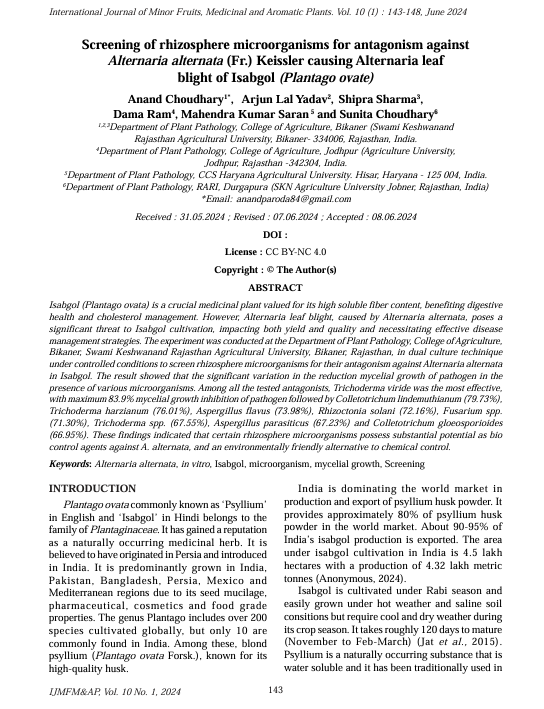
Screening of Rhizosphere Microorganisms for Antagonism against Alternaria alternata (Fr.) Keissler causing Alternaria leaf blight of Isabgol (Plantago ovate)
Authors: Anand Choudhary, Arjun Lal Yadav, Shipra Sharma, Dama Ram, mahendra Kumar Saran and Sunita Choudhary
Journal: International Journal of Minor Fruits, Medicinal and Aromatic Plants
Volume: 4.77 Issue: Year: 2024
Isabgol (Plantago ovata) is a crucial medicinal plant valued for its high soluble fiber content, benefiting digestive health and cholesterol management. However, Alternaria leaf blight, caused by Alternaria alternata, poses a significant threat to Isabgol cultivation, impacting both yield and quality and necessitating effective disease management strategies. The experiment was conducted at the Department of Plant Pathology, College of Agriculture, Bikaner, Swami Keshwanand Rajasthan Agricultural University, Bikaner, Rajasthan, in dual culture techinique under controlled conditions to screen rhizosphere microorganisms for their antagonism against Alternaria alternata in Isabgol. The result showed that the significant variation in the reduction mycelial growth of pathogen in the presence of various microorganisms. Among all the tested antagonists, Trichoderma viride was the most effective, with maximum 83.9% mycelial growth inhibition of pathogen followed by Colletotrichum lindemuthianum (79.73%), Trichoderma harzianum (76.01%), Aspergillus flavus (73.98%), Rhizoctonia solani (72.16%), Fusarium spp. (71.30%), Trichoderma spp. (67.55%), Aspergillus parasiticus (67.23%) and Colletotrichum gloeosporioides (66.95%). These findings indicated that certain rhizosphere microorganisms possess substantial potential as bio control agents against A. alternata, and an environmentally friendly alternative to chemical control.
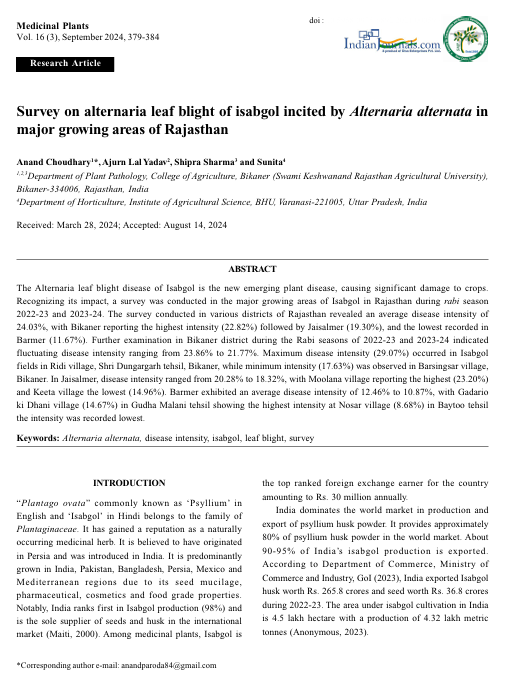
Survey on Alternaria leaf blight of Isabgol incited by Alternaria alternate in major growing areas of Rajasthan
Authors: Anand Choudhary, Arjun Lal Yadav, Shipra Sharma and Sunita
Journal: Medicinal plants
Volume: 5.25 Issue: Year: 2024
The Alternaria leaf blight disease of Isabgol is the new emerging plant disease, causing significant damage to crops. Recognizing its impact, a survey was conducted in the major growing areas of Isabgol in Rajasthan during rabi season 2022-23 and 2023-24. The survey conducted in various districts of Rajasthan revealed an average disease intensity of 24.03%, with Bikaner reporting the highest intensity (22.82%) followed by Jaisalmer (19.30%), and the lowest recorded in Barmer (11.67%). Further examination in Bikaner district during the Rabi seasons of 2022-23 and 2023-24 indicated fluctuating disease intensity ranging from 23.86% to 21.77%. Maximum disease intensity (29.07%) occurred in Isabgol fields in Ridi village, Shri Dungargarh tehsil, Bikaner, while minimum intensity (17.63%) was observed in Barsingsar village, Bikaner. In Jaisalmer, disease intensity ranged from 20.28% to 18.32%, with Moolana village reporting the highest (23.20%) and Keeta village the lowest (14.96%). Barmer exhibited an average disease intensity of 12.46% to 10.87%, with Gadario ki Dhani village (14.67%) in Gudha Malani tehsil showing the highest intensity at Nosar village (8.68%) in Baytoo tehsil the intensity was recorded lowest.
Efficacy of Plant Extracts against Anthracnose disease caused by Colletotricumtruncatum in Green Gram
Authors: Kailash Patel, A. L. Yadav , Sushanti Thochom, S. K. Maheshwari, Rahul Jakhar, Sunita Dhaka
Journal: Journal of Eco-friendly Agriculture
Volume: 5.36 Issue: Year: 2024
Evaluation of Fungicides Against Disease in Green Gram under in vitro and Pot Conditions
Authors: Kailash Patel, A. L. Yadav, D. R. Kumhar, Ashok Kumar, V S Acharya, Mukesh Jakhar , S K Maheshwari
Journal: Agriculture Science Digest
Volume: 5.52 Issue: Year: 2024
Management of Sclerotinia Rot of Chickpea (Cicer arietinum) incited by Sclerotinia sclerotiorum
Authors: M. K. Seshma, D. R. Kumhar, S. L. Godara, A. L. Yadav, Dinesh Kumar and Prahlad
Journal: Legume Research-An International Journal
Volume: 6.0 Issue: Year: 2023
ABSTRACT 10.18805/LR-5034
Background: Sclerotinia sclerotiorum (Lib.) de Barry is a soil-borne plant pathogen, capable of infecting more than 500 host plant species worldwide and plays a crucial role in reducing the yield of economically important crops.
Methods: A field experiment was conducted to manage Sclerotinia rot of chickpea using bioagents, fungicides, soil amendments and plant extract for two crop seasons using variety GNG-1581 in field under artificial inoculation conditions. Observations on Sclerotinia rot incidence were recorded periodically. The grain yield was also recorded at harvest.
Result: A combination of seed (5+5 g/kg seeds) as well as soil (5+5 kg/ha) application of T. harzianum + P. fiuorescens and foliar spray of carbendazim 12% + mancozeb 63% @ 0.2 per cent was found to be most effective reducing Sclerotinia rot (84.59%) and in enhancing grain yield (87.50%).
Isolation and Characterization of Streptomyces alkaliphilus from Thar Desert Rhizosphere with Plant Growth Promoting and Antifungal activates.
Authors: Kailash Patel, A. L. Yadav, Saba Khan, Sweety Poonia, Kallagunta Navyasree and Dhanushree G. K.
Journal: Kavaka
Volume: 4.22 Issue: Year: 2023
Evolution of Different Fungicides against Phomopsis blight disease of Brinjal under in vitro condition
Authors: Sunita Dhaka, Ashok Kumar, R. P. Meena, D. R. Kumhar, Narendra Singh, B. D. S. Nathawat, A.L. Yadav and B. S. Mitharwal
Journal: Agriculture Science Digest
Volume: 5.52 Issue: Year: 2022
Anthracnose of Soyabean: Occurrence , Epidemiology and management Apporaches
Authors: Manoj Kumar Yadav, Chandrakant Singh, Dasari Sreekanth, Aditya Kumar, Sujit Kumar, Sanjeev Kumar, P Duraimurugan, Archana Anokhe, Arjun Lal Yadav
Journal: Journal of Oilseed Research
Volume: 4.78 Issue: Year: 2022